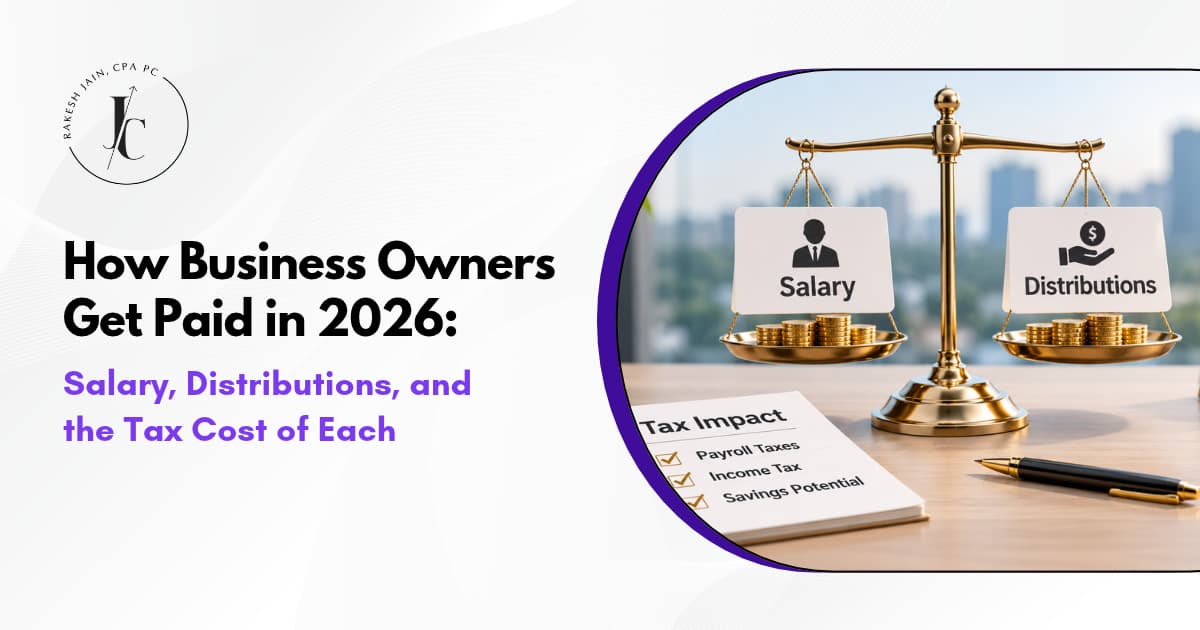
How Business Owners Get Paid in 2026: Salary, Distributions, and the Tax Cost of Each
On this page
- The first question is how your business is taxed
- What happens when there are two or more LLC members?
- The S-corp option: salary and distributions
- How much salary is reasonable? The IRS gets a say
- The QBI deduction can change the answer
- C-corporations have a different problem
- The basis issue that owners often discover too late
- Getting the payment right is only half the job
- FAQs
Ask a business owner how they pay themselves, and you will often get the same answer: "I just take what I need."
Fair enough. The business has money in the bank, the owner has bills to pay, and transferring some cash into a personal account doesn't feel like something that needs much thought. Until the tax return arrives.
The problem is that the IRS doesn't look at a bank transfer and decide what it is based on the description written beside it. Calling a payment an owner's draw, salary, or distribution doesn't settle its tax treatment. The business's tax classification does that.
We come across owners who have been running their businesses for years and still aren't entirely sure whether they should be taking a salary, making distributions, or simply transferring money when they need it. It matters more than they think. Get it wrong, and the business may end up paying payroll taxes it could have avoided or facing a much less pleasant conversation with the IRS.
And then there's the other side of it. Some owners are so focused on reducing tax that they forget the business has to keep enough cash to operate.
Let's look at how the different arrangements work.
The first question is how your business is taxed
An LLC is a legal business structure. It doesn't automatically tell you how the IRS will tax the business. A single-member LLC, for example, is generally treated as a disregarded entity for federal income tax purposes unless it elects corporate treatment. A multi-member LLC is generally treated as a partnership by default.
That distinction changes how the owner gets paid.
Take a single-member LLC that hasn't elected to be taxed as a corporation. The owner doesn't put themselves on payroll and issue themselves a W-2. They take an owner's draw. That's simply money transferred from the business account to the owner's personal account.
Here's where people get caught.
Say your business makes $150,000 in profit during the year. You take $90,000 out for personal expenses and leave the remaining $60,000 in the business account. It might feel as though you've only paid yourself $90,000. For tax purposes, however, the business profit is still $150,000. You are generally taxed on the profit, whether you withdraw it or leave it sitting in the account.
The money left behind isn't a tax deduction. It is still your business income.
Self-employment tax adds another cost. It is generally calculated on 92.35% of net earnings at a combined rate of 15.3%. Social Security accounts for 12.4%, up to the 2026 wage base of $184,500. Medicare adds another 2.9%, without the same wage ceiling. Higher earners may also owe the additional 0.9% Medicare tax once they cross the applicable income threshold.
There is some relief: generally, half of the self-employment tax can be deducted when calculating adjusted gross income. But the deduction doesn't cancel the tax itself.
For a business making a healthy profit, that bill can be uncomfortable. It's often around this point that somebody brings up an S-corp election. And yes, it can help. But before making that decision, it is worth understanding what changes and what doesn't.
What happens when there are two or more LLC members?
A multi-member LLC is generally taxed as a partnership unless it has elected corporate treatment. The owners are partners for federal tax purposes, and partners generally cannot be treated as W-2 employees of their own partnership.
So, the usual salary arrangement isn't available.
Instead, there are guaranteed payments and distributive shares.
Guaranteed payments are amounts paid to a partner for services or the use of capital. The payment is determined without regard to whether the partnership makes a profit. In other words, a partner may be entitled to the agreed payment even in a year when the business has had a poor run.
The partnership generally deducts the payment when calculating its business income, while the partner reports it as income. Self-employment tax may also apply.
Then there is the distributive share. This is the partner's share of the partnership's taxable income, worked out under the partnership agreement and the applicable tax rules. The partner can owe tax on that share even when the partnership hasn't actually handed over the cash.
This is the part that can cause arguments. One partner may have taken money out regularly, another may have left everything in the business, and both may discover that their tax allocations don't match what they thought they had received.
We made a similar point in our earlier article on home office deductions for LLC owners. Many operating agreements are copy-paste jobs. Nobody pays much attention to the wording when the business is formed, but years later, when partners disagree about expenses or payments, the agreement suddenly becomes very important.
Our advice is to settle the payment arrangements before the money starts moving. Don't leave guaranteed payments, profit allocations, and distribution rights to an informal understanding between the owners.
The S-corp option: salary and distributions
This is where things get interesting for owners looking to reduce self-employment tax.
An LLC can elect to be taxed as an S-corporation, provided it meets the eligibility requirements. An eligible corporation can also make the election. Once the business is taxed as an S-corp, a working owner generally wears two hats: shareholder and employee.
The employee gets a salary. The shareholder may also receive distributions.
The salary goes through payroll, with a W-2 issued at the end of the year. Social Security and Medicare taxes apply. The employee's share is generally 7.65%, and the company pays another 7.65% as the employer. The company can generally deduct the salary and its employer share of payroll taxes.
Distributions are treated differently. They are paid to the owner in their capacity as a shareholder and, when properly classified, are generally not subject to Social Security and Medicare taxes.
That difference is the reason many profitable businesses consider S-corp status.
Let's put some numbers against it.
Assume a business has $150,000 in profit before considering owner compensation and the other adjustments needed for a full tax calculation. If it operates as a single-member LLC taxed as a sole proprietorship, self-employment tax on 92.35% of that profit would be approximately $21,194.
Now assume the business elects S-corp treatment and pays its owner a salary of $70,000. Combined employee and employer Social Security and Medicare taxes on that salary would be approximately $10,710.
The apparent difference is about $10,484.
Looks good on paper. But don't start spending that savings just yet.
The comparison doesn't include payroll processing costs, state unemployment taxes, state-level S-corp taxes where applicable, or the effect of the half self-employment tax deduction under the first arrangement. It also doesn't account for the QBI deduction, which can change the final result. Most importantly, it assumes that $70,000 is a reasonable salary for the work the owner actually performs.
That last assumption is not a small one.
How much salary is reasonable? The IRS gets a say
An S-corp owner who works in the business cannot simply pay themselves a token salary and take the rest as distributions. The IRS expects reasonable compensation for the services performed.
There is no official 60/40 rule. There is no magic percentage that makes a salary acceptable just because somebody at a networking event recommended it.
Consider an owner who pays themselves $15,000 in wages and takes another $135,000 as distributions. If that owner is running the business full-time, managing employees, bringing in customers, and handling day-to-day operations, the salary is likely to attract questions. The IRS can reclassify payments as wages where they are really compensation for services. That can mean additional payroll taxes, penalties, and interest.
So what does the IRS look at?
The actual work. The owner's training and experience, responsibilities, time spent in the business, the company's history of payments, what other employees earn, and what comparable businesses pay for similar work. Any compensation agreement or formula used to arrive at the salary may also matter.
A business owner who spends ten hours a week overseeing a company is in a different position from someone who works fifty hours, handles sales, manages staff, and provides the service that generates most of the revenue.
We would not pick a salary by starting with a percentage of profit. Start with the job. What would the company have to pay another person to do the same work? How many hours would that person put in? What experience would the role require?
Write the reasoning down when the salary is set. We have always preferred a compensation memo prepared at the time of the decision to an explanation assembled after the IRS has already asked questions. The latter is rarely a comfortable exercise.
There's another S-corp detail that gets missed. Health insurance premiums paid for a shareholder owning more than 2% of the company generally have to be included in the shareholder's Form W-2 wages for income tax purposes. Where the conditions are met, those premiums are generally excluded from Social Security and Medicare wages, and the shareholder may qualify for an above-the-line deduction.
The reporting matters. If the owner pays the premiums personally and the company never records them properly through payroll, the deduction can be put at risk.
The QBI deduction can change the answer
The qualified business income deduction is another reason not to settle on an S-corp salary by looking at payroll tax alone.
Eligible owners may deduct up to 20% of qualified business income, subject to the applicable income limits and other restrictions. The One Big Beautiful Bill Act made the deduction permanent, retained the 20% rate, and changed certain income thresholds and related rules. It also introduced a $400 minimum deduction for qualifying taxpayers with at least $1,000 of QBI from an actively conducted business.
Here's the problem for S-corp owners: their W-2 salary is not QBI.
If an owner increases salary, the business has more wages subject to payroll taxes, while the amount of business income potentially eligible for the QBI deduction becomes smaller. But the calculation doesn't always point in the same direction. For owners above the relevant income thresholds, the W-2 wage limitation can restrict the deduction. In those circumstances, paying more wages may actually help.
This is why the lowest possible salary isn't necessarily the best salary.
We would rather see an owner calculate the payroll tax cost alongside the QBI deduction than save a little on one side and lose more on the other. The numbers should be reviewed every year. A business that made $150,000 last year may be making twice that now, and the owner's responsibilities may have changed along with it.
C-corporations have a different problem
A C-corporation pays federal income tax on its own taxable profits, generally at 21%.
If the company pays its working owner a reasonable salary, that salary is generally deductible to the corporation. The owner reports the wages on their personal return.
Dividends are another matter. They come out of profits that have already been taxed at the corporate level. The shareholder may then owe tax on receiving them, generally at 0%, 15% or 20%, depending on the type of dividend and the shareholder's income. Higher-income taxpayers may also face the 3.8% net investment income tax.
That's the familiar double-tax issue with C-corporations.
It doesn't mean a C-corp is always the wrong choice. Some businesses want to retain profits for expansion, bring in investors, or operate under a structure that makes more sense for their longer-term plans. But an owner who simply wants to take most of the company's profit home should understand the second layer of tax before choosing this structure.
A salary and a dividend are not interchangeable. The company needs to account for them properly.
The basis issue that owners often discover too late
There is one more thing to check before making distributions: basis.
For an S-corp shareholder, stock basis and debt basis affect the tax treatment of losses and certain other items. For a partner, outside basis determines, among other things, how much of a distribution can generally be received without immediate tax. The rules are different, so the two should not be treated as identical.
The practical point is simple enough. A distribution is not automatically tax-free just because the money is coming out of a business the owner owns.
Contributions, allocated income, losses, distributions, and certain loans can all affect basis. If the business has been losing money and the owner has continued taking cash out, there may be a tax consequence that wasn't expected. A distribution exceeding the relevant basis can trigger gain.
Keep track of it during the year. Trying to reconstruct several years of contributions, losses and withdrawals when the business is being sold is nobody's idea of a good time.
Getting the payment right is only half the job
When we review owner compensation, the first thing we look at is the entity and whether it makes financial sense for the business.
An S-corp election that saves $2,000 in payroll tax but adds $3,000 in payroll and compliance costs is a bad trade. We would rather tell an owner to wait than recommend an election simply because it sounds tax-efficient. The business has to make enough profit to support the arrangement.
Then comes the salary. For an S-corp owner, the figure needs written support and should be revisited when the work changes. A salary that made sense when the company had two employees may not make sense when it has twenty.
The payment schedule needs attention as well. Salary should run through payroll, with withholding and tax deposits handled on time. Distributions should be recorded separately. And estimated tax payments need to be planned during the year, rather than left until the accountant starts preparing the return.
One issue we keep coming back to is cash flow. Owners sometimes look at the bank balance, see $80,000 sitting there, and assume they can take a large part of it home. But some of that money may already be spoken for. Payroll is due. Suppliers need to be paid. Taxes are coming up. There may be equipment to replace or a slow month around the corner.
The bank balance isn't the same thing as available profit.
We made much the same point in our home office deduction article: an S-corp election only works properly when the paperwork behind it works too. The same applies here. A reasonable salary on paper doesn't help much if payroll hasn't been run correctly, and a distribution that looks harmless in the bank statement may create a problem if the basis hasn't been checked.
Rakesh Jain, CPA PC, can review how you currently pay yourself, compare the available options against your business profit, and help put the payroll and supporting records in order. It is a conversation worth having before the next payment goes out, rather than after the tax return raises a question nobody expected.
FAQs
How should an LLC owner pay themselves in 2026?
It depends on how the LLC is taxed and how many members it has. A single-member LLC that has not elected corporate treatment generally pays its owner through draws, while tax is calculated on the business profit. A multi-member LLC generally pays partners through draws and, where agreed, guaranteed payments. An LLC taxed as an S-corp can pay a working owner a reasonable W-2 salary and make distributions.
What is a reasonable salary for an S-corp owner?
There is no fixed percentage that applies to every S-corp. The salary should reflect what the business would pay someone else to perform the owner's actual duties. The IRS may consider the owner's experience, responsibilities, hours worked, and comparable compensation. It is sensible to document how the figure was reached when the salary is set.
Are LLC distributions subject to self-employment tax?
For a single-member LLC taxed as a disregarded entity, self-employment tax generally applies to net business earnings whether or not the owner withdraws the money. In a multi-member LLC taxed as a partnership, guaranteed payments and the distributive share of many active partners may be subject to self-employment tax. An LLC taxed as an S-corp generally does not pay self-employment tax on properly classified distributions, although the working owner's salary is subject to payroll taxes.
Can an S-corp owner receive both a salary and distributions?
Yes. A working S-corp owner generally receives a reasonable salary through payroll and may also receive distributions as a shareholder. The salary must reflect the work performed, and distributions need to comply with the S-corp's ownership and single-class-of-stock rules. Distributions cannot be used as a replacement for wages.
Does it matter how often an owner takes money out of the business?
It does for S-corp salaries. Wages should be paid through a proper payroll process, with withholding and tax deposits made on time. A single payment at the end of the year may not meet the company's payroll obligations. For a sole proprietor's draws, the timing does not change the amount of taxable business profit, but estimated tax payments still matter. The usual 2026 federal estimated tax dates are April 15, June 15, and September 15, 2026, and January 15, 2027. The amount required depends on the taxpayer's circumstances and the applicable safe harbour rules.
This article is general information and isn't tax advice for your situation. The right treatment depends on the business structure, the owner's role, and the company's financial position. Speak with a qualified tax professional before changing how you pay yourself.

Written by
Rakesh Jain, CPA
Managing Director, Rakesh Jain, CPA PC
Rakesh is a Texas-licensed CPA and a Chartered Accountant (ICAI) with three decades of experience across audit, tax and CFO roles on three continents. He reviews every client file personally.
More about the firm