Home Office Deduction for LLC and S-Corp Owners in 2026: Why the Rules Differ and What to Use Instead
On this page
- First, does the room even count?
- How much can you deduct for a home office with a single-member LLC?
- Two owners, one LLC, and an agreement nobody read
- The S-corp twist
- The accountable plan, which is where the money comes back
- Home office audit risk, and the red flag myth
- What the home office tells us about the rest of your setup
- FAQs
Sooner or later, every owner running a business out of a spare bedroom wonders whether the room can come off their taxes. It can, mostly, though the route it takes depends on a decision most owners made years ago and haven’t thought about since, namely how the business is taxed.
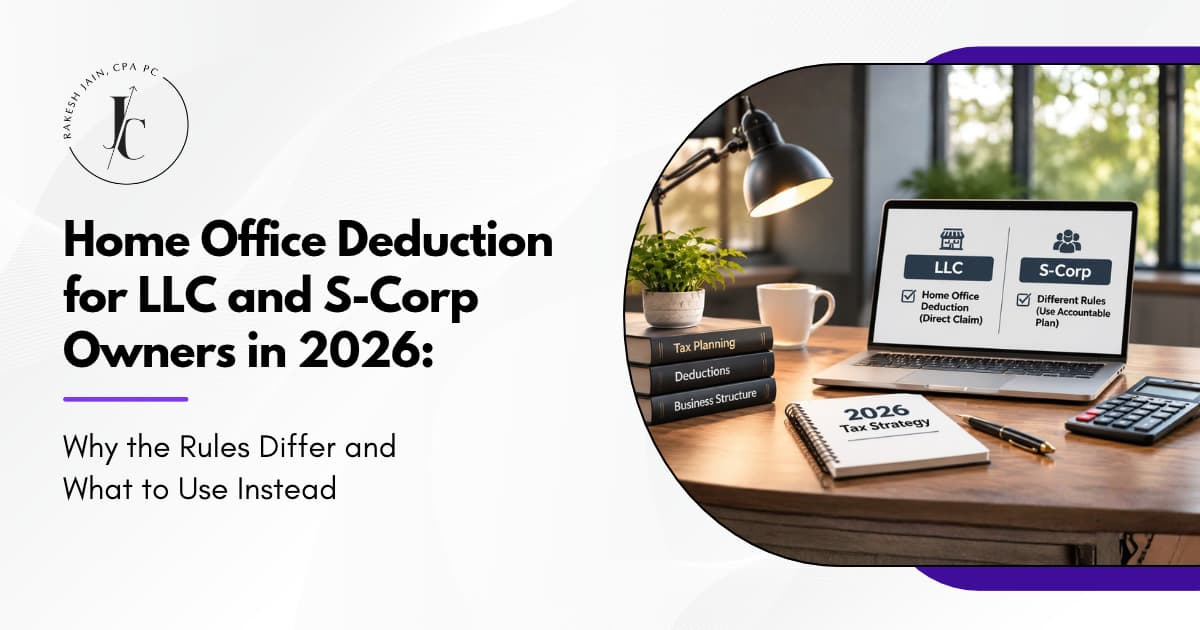
A single-member LLC owner claims the home office deduction on their own return, more or less the way people expect. An S-corp owner can’t claim it there at all. That one gap causes more confusion than anything else in this corner of the tax code, and in our view it’s partly down to how S-corp elections get pitched to owners (as a neat way to save payroll tax, with nobody mentioning what the election does to the home office).
First, does the room even count?
Under the home office deduction rules, everything starts with one airtight requirement. Your room has to be used regularly and exclusively for the business, and exclusive means exactly what it sounds like. A desk the kids borrow for homework on Sunday disqualifies it. So does a guest bed that gets made up every Thanksgiving, however hard you work in there the rest of the year (and yes, a treadmill that gets used counts against you too).
Beyond exclusive use, the room has to pass one of three location tests: it must be your principal place of business, a place where you regularly meet clients, or a separate structure such as a detached garage or studio. That first test is far wider than it looks. Admin counts, so if the invoicing and the bookkeeping happen at home and there’s no other fixed place where that work gets done, the office qualifies even if every paying job takes place on a client’s site. Contractors and consultants miss this constantly, which is a shame, because the deduction was theirs to take.
Our first piece of advice costs nothing. Measure the room, take a few dated photos of it and drop them in the tax file. If the question of exclusive use ever comes, it tends to arrive two or three years later, by which time nobody remembers where the guest bed was.
How much can you deduct for a home office with a single-member LLC?
For income tax, a single-member LLC is more or less invisible. It’s disregarded, so the business goes on Schedule C of the owner’s own Form 1040, and the home office sits right there with it. There are two ways to put a number on it, and the choice gets made afresh every year.
The simplified home office deduction gives you five dollars a square foot, capped at 300 square feet, which means it can never be worth more than $1,500 in a year. That rate has sat at $5 since the IRS introduced the method in 2013, untouched by a decade of rising rents. It asks for no receipts and involves no depreciation; hence nothing gets taxed back when the house is sold, and anyone who itemises keeps their mortgage interest and property taxes on Schedule A in full.
Form 8829, the regular method, works from the real costs of the home, and for anyone paying big-city rent, the simplified method does not hold a candle to it. Take a 200-square-foot office in a 2,000-square-foot apartment. That’s 10% of the home, and at $3,000 a month in rent, 10% of a year’s rent comes to $3,600 before utilities and insurance are even added. On the same room, the simplified method gives you $1,000. Our position is blunt: work out both every year and claim the bigger number, because the method has to be picked on the original return, filed on time, and there’s no switching once that return is in.
There are two catches, mind you. First, the deduction can’t drag the business into a loss, though whatever is disallowed carries forward to next year. And if you own the home, the depreciation on the office part gets taxed when you sell, at up to 25%. Some owners try to dodge this by leaving depreciation off the form altogether, which is the worst deal going, since the IRS taxes the depreciation you were entitled to take whether or not you took it, so you lose the deduction and pay the tax anyway. Where the office sat inside the house itself, the home-sale exclusion can usually still shelter the rest of the gain on that part of the home, and only the depreciation is exposed.
Two owners, one LLC, and an agreement nobody read
Bring in a second member, and the LLC becomes a partnership for tax purposes, by default, which closes the Schedule C door. Partners can’t be employees of their own partnership either, so the employee route is shut as well, and two options remain.
Under the first, the partnership pays each partner back for home office costs through a written reimbursement policy, wherein the partnership deducts the payment, and the partner owes nothing on it. Under the second, the partnership agreement says partners must carry certain costs themselves, and each partner then deducts those costs on Schedule E as unreimbursed partnership expenses.
We’ll go further and say that most LLC operating agreements are copy-paste jobs, and this is where that comes back to bite. A partner who was entitled to be paid back and never asked loses the deduction outright, and nobody reads the clause that decides it until the question is already on the table. Pick a route and write it down before anybody files.
The S-corp twist
Plenty of LLCs have elected to be taxed as S-corps, and once that election is made, the S-corp rules govern, whatever the formation documents happen to say. Thus, an S-corp owner who works in the business is, in the eyes of the IRS, an employee of their own company, with a salary run through payroll and a W-2 at year-end, and an employee’s home office costs fall under what the tax code calls miscellaneous itemized deductions.
Those deductions were suspended by the 2017 tax law from 2018 onwards, and for years there was a reasonable hope they’d return after 2025, when the suspension was due to lapse. Then came the One Big Beautiful Bill Act, signed in July 2025, which buried that hope by making the suspension permanent. An S-corp owner gets no home office deduction on the personal return in 2026, or in any year after it. Nevertheless, the money is still there for the taking, provided it comes back through the company.
The accountable plan, which is where the money comes back
An accountable plan is a reimbursement arrangement between the corporation and its employees, and the owner-employee is one of them. Done properly, the S-corp deducts what it pays back, and the owner owes neither income tax nor payroll tax on the money. For a home office, the company typically reimburses the business share of the household costs every month or quarter, worked out with the same square footage percentage that would go on Form 8829.
Treasury Regulation 1.62-2 lays down the conditions. To qualify, the cost has to be connected to work done for the company, and it has to be backed by records within a reasonable time, coupled with a duty to hand back any amount advanced beyond what was spent. It even defines "reasonable" by way of a safe harbor: 60 days to account for an expense and 120 days to return any excess. Fail those tests and the payments are treated as wages, payroll tax, and all, which renders the whole exercise pointless.
We have firm views on how these should run. For a start, the plan belongs in writing, approved by corporate resolution, since the regulation doesn’t strictly demand a formal document, but an examiner will ask for one. Amounts should come from the bills themselves, and we don’t use the $5 simplified rate for reimbursements, because that rate exists for claiming a deduction on a return, and a reimbursement ought to follow what the house costs. Payments go out during the year, every year. A lump sum in March covering all of last year, with no expense reports behind it, is a W-2 waiting to happen. And if the company pays back part of the mortgage interest and property tax, that part comes off what you claim on Schedule A, because the same dollar can’t be deducted twice (the IRS has never been charitable about double-dipping).
There’s one more box to tick. The IRS wants a business reason for working from home, which it calls the convenience of the employer. Where the company has no other office, that’s easy to show, but write it into the plan or the board minutes all the same.
Home office audit risk, and the red flag myth
Few tax myths get repeated as often as the idea that a home office deduction invites an audit, to the point where people treat it as law. To a great extent, it’s folklore. Nobody outside the IRS knows exactly how returns get selected, since the agency doesn’t publish it, and we haven’t come across any published data showing that this deduction, on its own, makes an audit more likely. What does matter is whether the claim stands up when somebody asks. For an LLC owner, standing up means measurements and photos of the office plus the bills behind every line of Form 8829. For an S-corp owner, it means the plan document, the expense reports, and entries in the company’s books that match what was paid and when.
Most errors we come across are a textbook example of small things left too long. S-corp owners claim the home office on their personal return. Accountable plans sit in a drawer while money goes out with no paperwork whatsoever. Some offices double as the room where the family watches TV. And homeowners sell up with no idea that the depreciation on the office is about to be taxed (usually in the very year they were hoping for a quiet return).
What the home office tells us about the rest of your setup
On its own, the home office is rarely a big number, but it says a great deal about everything around it. If you elected S-corp status to save on self-employment tax and nobody set up an accountable plan for you, somebody dropped the ball, and the home office is almost never the only casualty; mileage and the phone bill usually go down with it. An S-corp election only pays for itself when the plumbing behind it works.
Rakesh Jain, CPA PC, can tell you which of these routes fits your business, and where the company needs one, draft the accountable plan.
FAQs
Can an LLC owner deduct a home office?
In most cases, yes. You must use the room regularly and only for the business, and it has to pass one of the IRS location tests, most often by being your principal place of business. A single-member LLC owner claims it on Schedule C with the simplified method or Form 8829, whereas members of a multi-member LLC go through the partnership, either by being paid back under a written policy or, where the agreement says they carry the costs, by deducting them on Schedule E.
Can an S-corp owner deduct a home office?
Not on their own return, no. Their company has to pay them back under an accountable plan and take the deduction itself.
What is an accountable plan?
A written arrangement wherein a company pays its employees back for business costs they’ve covered out of pocket. To count, the cost must relate to the business and be backed by records, and any extra money advanced goes back to the company within a reasonable time. Meet those terms, and the payments are deductible for the company and tax-free for the employee; miss them, and the IRS treats the payments as wages.
What is the simplified home office method?
Five dollars per square foot of office, up to 300 square feet, so $1,500 at most. There’s nothing to add up, and no depreciation to claim, and self-employed owners who file Schedule C can pick it, or the regular method, each year on the original return.
Can employees claim a home office deduction?
Not federally. W-2 employees lost the deduction for unreimbursed work expenses in 2018, and the change is now permanent, so the only federal route left is to have the employer pay you back under an accountable plan. California still allows some unreimbursed employee expenses on its state return, above 2% of income, so it pays to check your own state’s rules.
This article is general information and isn’t tax advice for your situation. The right treatment depends on your facts, so speak with a qualified tax professional before acting on it.

Written by
Rakesh Jain, CPA
Managing Director, Rakesh Jain, CPA PC
Rakesh is a Texas-licensed CPA and a Chartered Accountant (ICAI) with three decades of experience across audit, tax and CFO roles on three continents. He reviews every client file personally.
More about the firm