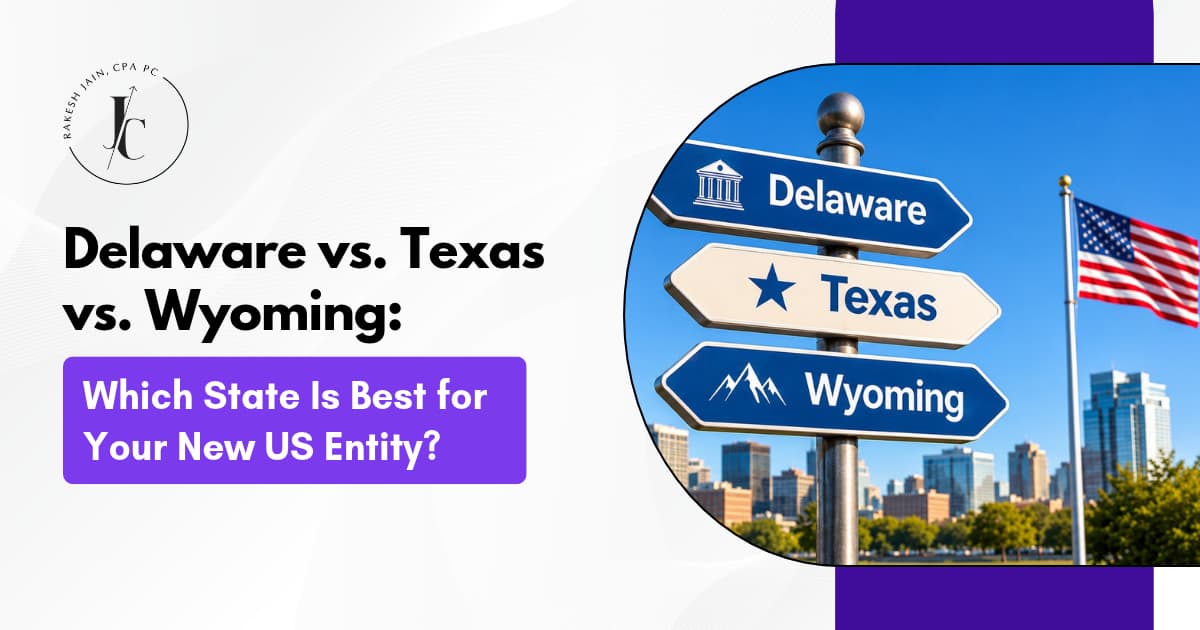
Delaware vs. Texas vs. Wyoming: Which State Is Best for Your New US Entity?
On this page
- First, the state where you form isn't necessarily the state where you operate
- Delaware: you aren't paying for the cheapest filing
- Texas: the home-state advantage is easy to overlook
- Wyoming: cheap to maintain, but is that enough?
- The costs look different when you put them together
- Non-resident founders: don't stop at the state registration
- Our take: don't choose a state because somebody on the internet recommends it
- FAQs
There is a piece of advice that seems to follow almost every person planning to start a US company: form in Delaware. If not Delaware, then Wyoming. And if you happen to be looking at Texas, well, it has no personal income tax, so that must be worth something.
It is. All three states have their advantages. But the advice is often given without asking the one question that should come first: what is the business actually going to do?
A founder setting up an online consultancy from outside the US has very different requirements from a startup preparing for a venture capital round. And neither has much in common with someone opening an office, hiring employees, and running a business out of Houston.
Yet all three are often handed the same list of supposedly best states.
We would be careful with those lists. The cheapest state to form a company in is not necessarily the cheapest state to operate it from. In fact, choosing the wrong state can leave you paying two sets of annual fees, maintaining two registered agents, and keeping track of filings in places where you may never have intended to do business.
Let's take a closer look.
First, the state where you form isn't necessarily the state where you operate
This is probably the most important part of the entire decision, and it is usually buried somewhere near the bottom of online formation guides.
A company formed in Delaware is a Delaware domestic entity. Once it starts doing business in another state, it may also have to register there as a foreign entity. The same applies to a Wyoming LLC or a Texas corporation operating elsewhere.
The exact test for doing business varies from state to state. Having a customer in another state does not automatically mean that registration is required. But an office, employees, or a genuine operating presence can certainly bring those obligations into play.
Consider a founder who forms an LLC in Wyoming because the annual fee is low. The founder then moves the actual business operations to Houston. Wyoming still wants its annual report and license tax. Texas may also require foreign qualification, franchise tax reporting, and the relevant information filing.
So the founder has not escaped Texas compliance. They've added Wyoming to it.
The same thing happens when someone forms a Delaware company and runs it from Dallas. Delaware remains the company's formation state, but Texas obligations do not disappear simply because the certificate of formation came from somewhere else. Delaware itself explains that foreign entities doing business in the state may need to qualify there too.
There are exceptions, of course, and the registration question needs to be checked against the activities of the particular business. But the basic point is worth remembering: forming somewhere else does not automatically remove the rules of the state where you actually work.
For founders living outside the US, the calculation can be different. If there is no US office, no US staff, and no physical operating presence, Delaware or Wyoming may be perfectly reasonable choices. That still leaves federal tax filings and the founder's home-country tax position to consider.
And that is a separate conversation.
Delaware: you aren't paying for the cheapest filing
Delaware is popular for a reason. It has spent decades building a corporate legal system that investors, lawyers, and companies understand.
The Court of Chancery is a specialist court that deals with many business and corporate disputes without juries. More importantly, there is a substantial body of corporate case law behind it. When investors look at a company's governance documents, shareholder rights or board arrangements, they are dealing with a legal framework they already know.
That familiarity has commercial value.
A startup preparing to raise venture capital will often be advised to form a Delaware C-corporation. Some institutional investors expect it. Others may make it a condition of investment. Stock options, preferred shares, and future funding rounds can all be easier to structure within a framework that investors and their lawyers regularly work with.
But there is a distinction here that founders should not overlook. Delaware's reputation as the preferred state for venture-backed corporations does not mean every small business needs a Delaware LLC.
A single-owner consultancy operating from another state is unlikely to benefit much from Delaware's corporate legal infrastructure. The owner may simply be paying an annual fee for a system they never use.
What does Delaware cost in 2026?
For an LLC, the annual tax is $400, payable by June 1. It was previously $300, with the increase taking effect from the 2026 tax year under House Bill 400. Delaware does not require LLCs to file an annual report. Miss the payment deadline and the penalty is $200, with interest of 1.5% per month.
Corporations have a separate filing requirement. Their annual report and franchise tax are due by March 1. The annual report fee is $50, and the minimum franchise tax is generally $175 under the Authorized Shares Method or $400 under the Assumed Par Value Capital Method.
Now, there is something about the Delaware franchise tax that catches new founders off guard.
A corporation with a large number of authorised shares can receive a surprisingly high bill under the Authorized Shares Method. The amount may run into thousands of dollars. Some founders see the figure and assume they have no choice but to pay it.
Not necessarily.
The Assumed Par Value Capital Method uses the company's gross assets and issued shares to calculate the tax. Depending on the company's figures, the result can be considerably lower. It is worth checking both methods before paying a large bill. The first figure you see is not always the figure you should end up paying.
Delaware is a sensible choice when investors, governance arrangements, and future fundraising justify it. If none of those things applies, ask yourself what you are actually paying for.
Texas: the home-state advantage is easy to overlook
Texas gets a lot of attention because it has no individual state income tax. That is certainly attractive, but the business tax story is a little more involved.
Texas imposes a franchise tax on businesses that fall within its rules. The good news for smaller businesses is that the no-tax-due threshold is quite generous.
For the 2026 and 2027 report years, businesses with an annualized total revenue of $2.65 million or less generally owe no franchise tax. They are also no longer required to file the old No Tax Due Report. But, and this is the bit worth paying attention to, the relevant Public Information Report or Ownership Information Report still has to be filed.
We would not treat that as a minor administrative detail. Owners hear that they are below the threshold, assume they have nothing to file, and move on. The state still expects the information report.
For businesses above the threshold, the general franchise tax rate is 0.375% for retail and wholesale businesses and 0.75% for other businesses, applied to taxable margin. Eligible businesses with annualised revenue of $20 million or less may use the EZ computation at 0.331%. The usual reporting deadline is May 15.
Texas has also been trying to make itself more attractive as a place for complex commercial disputes. Its Business Court began operating in September 2024 and hears certain business cases. It is a meaningful development. Still, it would be premature to put it on the same footing as Delaware's established Court of Chancery. Texas is building its experience; Delaware has decades of it.
So who should form in Texas?
Quite simply, businesses that are actually going to operate there. If the owner lives in Texas, the office is in Texas, and employees are being hired there, a Texas entity will often be the straightforward option. Why create another state's compliance obligations when Texas is where the business is going to be run anyway?
A startup preparing for institutional funding may have a different reason to choose Delaware. But a local service business does not need to imitate a venture-backed technology company just because both happen to be LLCs or corporations.
Wyoming: cheap to maintain, but is that enough?
Wyoming has become a favorite among non-US founders. It offers relatively low annual costs, no individual income tax, and no corporate income tax. For someone running a small online business without a physical US presence, the appeal is fairly obvious.
The annual report license tax for an LLC is the greater of $60 or 0.0002 of the value of assets located and employed in Wyoming. In practical terms, a company with no significant Wyoming assets will generally pay the $60 minimum.
The annual report is due on the first day of the month in which the company was formed. Formed on May 18? The report is due on May 1 each year, not May 18. It is a small detail, but one that is easy to get wrong when several state deadlines are being managed at once.
Wyoming also has charging order protection under its LLC law. Broadly speaking, this can limit what a personal creditor of an LLC member can obtain from the member's interest in the company. It is one reason Wyoming is considered for certain asset-holding arrangements.
That said, it should not be sold as a magic shield. The actual protection depends on the structure, the operating agreement, the creditor's claim, and the law that applies. Anyone setting up an entity primarily to hold valuable assets should have the arrangement reviewed by a lawyer.
For a non-resident founder with an online store, consulting business, or holding company, Wyoming can be an economical option. No US office, no local employees, no immediate plans to raise institutional capital. The low annual state cost may make sense.
But what happens when the business grows?
Suppose the founder later opens a warehouse in Texas. The Wyoming LLC may now have Texas registration and reporting obligations as well. Or perhaps the company decides to raise venture capital, and investors want a Delaware C-corporation. The founder may then have to restructure or convert the business.
The original $60 annual fee starts looking rather less important.
Wyoming can be a good choice. It just isn't the answer to every US formation question.
The costs look different when you put them together
At first glance, Wyoming appears to win on annual cost. Delaware is more expensive, and Texas may have no franchise tax for businesses below its threshold.
But the state fee is only one part of the bill.
| What you're considering | Delaware | Texas | Wyoming |
|---|---|---|---|
| LLC annual state cost | $400, due June 1 | Franchise tax may be zero below the threshold; information filing still applies | $60 minimum, based on Wyoming assets |
| Corporation filings | Annual report and franchise tax due March 1 | Franchise tax and information-reporting requirements | Annual report and license tax |
| Individual income tax | Applies to residents | No individual income tax | No individual income tax |
| Investor familiarity | Strong, particularly for venture-backed corporations | Growing business law infrastructure | Less established for institutional venture funding |
| Main attraction | Corporate law and investor familiarity | Practical choice for businesses operating there | Low annual state cost |
| Possible drawback | Extra expense where the business operates elsewhere | Reporting obligations remain even below the tax threshold. | Foreign qualifications elsewhere can add costs |
The table is useful, but it doesn't tell the whole story. Registered agent fees, foreign qualification, state licenses, federal tax returns, and professional fees can all change the total.
A founder should compare the cost of maintaining the entity for three or five years, not just the amount paid on the day of formation.
Non-resident founders: don't stop at the state registration
For founders outside the US, the formation process can look deceptively simple. You choose a state, appoint a registered agent, file the documents, and receive confirmation that the LLC exists.
Then the compliance questions begin.
Neither Delaware nor Wyoming generally requires a non-resident owner to rent a physical office simply to form an LLC. Both do require a registered agent with a physical address in the state. The agent receives official correspondence and legal documents, and the service normally carries an annual fee.
There is also the federal tax side.
One form that deserves attention is Form 5472. A foreign-owned US disregarded entity may be required to file Form 5472 along with a pro forma Form 1120 when it has reportable transactions with its foreign owner or related parties. The filing obligation is not limited to businesses making a profit. A failure to file a complete and correct Form 5472 can result in a $25,000 penalty.
This is not a form to discover after the first year has passed. The reporting position should be checked when the entity is established, particularly where the owner is transferring money into the company, paying expenses on its behalf or receiving payments from it.
Beneficial ownership reporting has changed too. Quite considerably, in fact.
FinCEN's final rule, effective August 14, 2026, exempts companies created in the US from federal BOI reporting. Certain companies formed under foreign law and registered to do business in a US state may still have to report, subject to the relevant exemptions. A US-created LLC owned by a foreign individual should not be confused with a foreign company registering to operate in the US. The distinction matters.
And then there is the bank account.
A company can be properly formed, have its EIN, and have all its documents in order, yet still spend weeks dealing with bank verification. Banks have their own requirements for non-resident owners. They may ask for identification, proof of address, formation documents, details of the business activity, and information about the beneficial owners.
The state you choose does not guarantee that a bank will open an account for you.
One final point, especially relevant to founders living abroad: the US may not classify your LLC in the same way your home country does. The tax treatment of the entity, its profits and distributions may differ between the two countries. A structure that looks straightforward from the US side can create complications elsewhere.
We would want that checked before formation. Not after the money starts coming in.
Our take: don't choose a state because somebody on the internet recommends it
There isn't a universal winner here. And we would be suspicious of anyone who tells every founder to use the same state regardless of the business.
A startup preparing to raise venture capital will usually have a strong reason to choose Delaware, often as a C-corporation. The legal framework and investor familiarity can make the additional annual cost worthwhile.
A business with its operations, staff, and office in Texas will often be better served by forming in Texas. It already has to deal with Texas rules, so adding another state's annual obligations may achieve very little.
For a founder abroad running an online business without US operations or institutional investors, Wyoming can be a sensible low-cost option. The annual state filing cost is hard to argue with. Just remember that federal filings, banking, and home-country tax treatment are separate matters.
The mistake is treating the formation fee as the whole decision. It isn't. The real cost appears over the years that follow: annual taxes, information reports, registered agents, foreign qualification, and the professional work needed to keep everything in good standing.
We have seen how a structure that looked inexpensive at the start can become unnecessarily complicated once the business begins operating in another state. And changing the structure later, particularly when investors are involved, is not always a simple administrative exercise.
Rakesh Jain, CPA PC helps founders in the US and abroad choose an appropriate state and entity structure, understand the tax and filing obligations, and manage the compliance work that follows. It is much easier to get the structure right before formation than to untangle it after the business has grown.
FAQs
Should I incorporate my startup in Delaware or Texas?
If you expect to raise institutional venture capital, Delaware is generally the stronger option. Investors and their lawyers are familiar with its corporate law framework, and many prefer a Delaware C-corporation. If the business is going to operate from Texas and has no immediate plans for institutional funding, forming in Texas may be simpler and avoid maintaining an additional state registration.
Do non-resident founders need a physical office in Wyoming or Delaware?
Generally, no. A non-resident founder does not need to rent an office simply to form an LLC in either state. Both require a registered agent with a physical address in the state to receive official documents. Banks and payment processors may have their own address and verification requirements, which are a separate issue.
What are the ongoing costs of a Delaware LLC in 2026?
A Delaware LLC pays an annual tax of $400, due June 1. It does not have to file an annual franchise tax report. Late payment attracts a $200 penalty and interest of 1.5% per month. If the LLC also operates in another state, it may have additional registration fees, annual filings, and taxes there.
This article is general information and isn't legal or tax advice for your situation. State requirements and filing fees can change, and the right structure depends on where the business operates, who owns it, and what it plans to do. Check the current requirements and speak with a qualified professional before forming an entity.

Written by
Rakesh Jain, CPA
Managing Director, Rakesh Jain, CPA PC
Rakesh is a Texas-licensed CPA and a Chartered Accountant (ICAI) with three decades of experience across audit, tax and CFO roles on three continents. He reviews every client file personally.
More about the firm