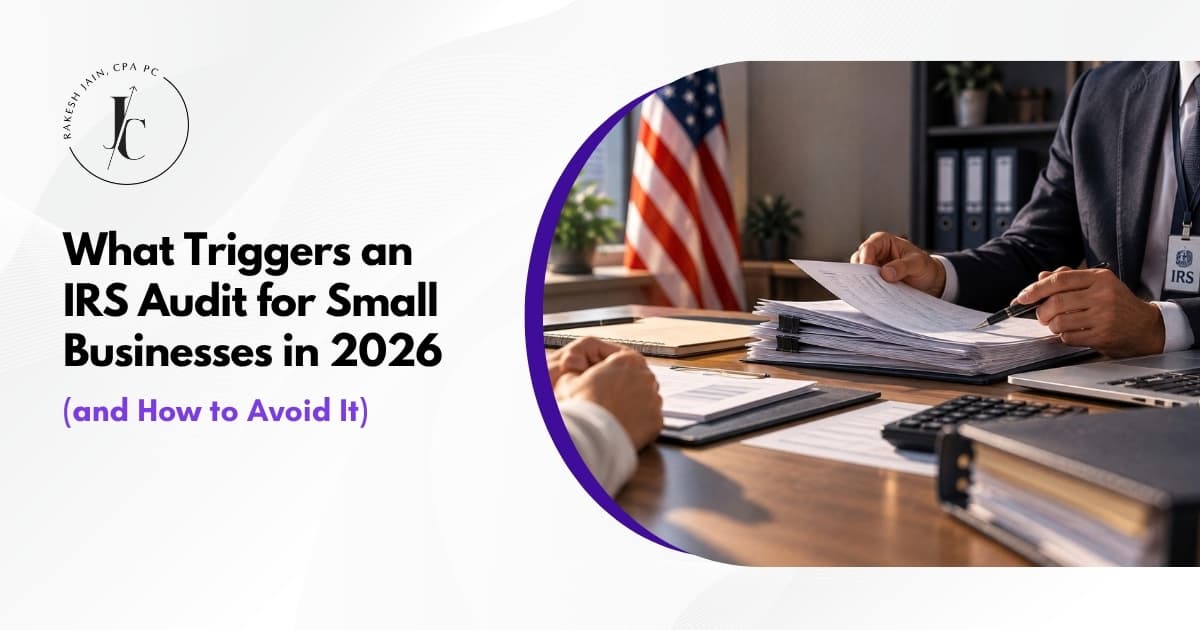
What Triggers an IRS Audit for Small Businesses in 2026 (and How to Avoid It)
On this page
Start with the base rate
The odds are lower than the anxiety suggests. Published IRS data has shown examination coverage in the range of well under one percent of individual returns and under one percent of corporate returns, with enforcement attention concentrated on large businesses and high-income filers.
That number is not the interesting part, though. The question worth asking is not how likely an audit is in general, but which features of a specific return move it above the base rate. Selection is not random.
The mechanism most people misunderstand
A return is usually flagged by a computer long before anyone reads it. Two systems do most of the work.
The first is information return matching. Every W-2, 1099-NEC, 1099-MISC, 1099-K, 1098, and K-1 issued to a taxpayer is filed with the IRS as well. The system compares those documents against the return. A mismatch generates a notice automatically, and this is the single most common contact a small business has with the IRS. It is not technically an audit, but it functions like one if the number cannot be explained.
The second is statistical scoring, which compares a return's ratios against others in the same industry and revenue band. A tax deduction that is large in isolation means nothing. A deduction that is large relative to peers with similar gross receipts is what moves a score.
The 2026 context matters here. IRS staffing has contracted substantially, which has reduced the number of traditional field examinations. That has not reduced scrutiny so much as shifted it toward the automated systems, which never required staffing in the first place. Fewer examiners means fewer, more targeted, and generally more thorough examinations.
The patterns that raise the score
Income that does not match the documents. The most reliable trigger there is. Includes forgotten 1099s, a 1099-K from a payment processor reporting gross settlements rather than net, and K-1 income from an entity the owner forgot filed.
Repeated losses. A business showing losses year after year invites the question of whether it is a business or a hobby under Section 183. The inquiry looks at profit motive, businesslike operation, and the owner's expertise, not just the numbers.
Deductions out of line with industry norms. Meals, travel, and vehicle costs running at a share of revenue far above comparable businesses.
Cash-intensive operations. Restaurants, construction, retail, and personal services face elevated attention because cash income is harder to verify and easier to omit.
Round numbers. A return full of figures ending in hundreds suggests estimates rather than records. It rarely triggers an examination alone, but it undermines credibility once one opens.
Unreasonably low S-corp salaries. A shareholder-employee taking large distributions and minimal wages is a well-documented examination pattern, and the reclassification remedy is straightforward for the IRS to apply.
Worker classification. Businesses issuing many 1099s to people who look, on the facts, like employees.
Personal expenses in business accounts. Usually discovered inside an examination rather than triggering one, and usually what expands its scope.
Two 2026 items that create new mismatch surfaces
The updated Form W-2 now carries separate reporting of qualified tips in Box 12 Code TP and qualified overtime in Code TT, with a Treasury Tipped Occupation Code in the new Box 14b. Forms 1099-NEC and 1099-MISC gained corresponding boxes. Every new reported field is a new field that can fail to match an employee's return, and 2025's transition relief does not carry into 2026.
Separately, the 1099-NEC and 1099-MISC reporting threshold rose from $600 to $2,000 for 2026 payments, that reduces filings. It does not change taxability, and a business that stops tracking payments below the threshold will struggle to substantiate those deductions later.
Calculation errors also became easier this year for business formation. The Section 179 limit moved to $2,560,000, and the business mileage rate changed mid-year from 72.5 cents to 76 cents on July 1. Anyone applying last year's figures, or applying one mileage rate across the whole of 2026, produces an arithmetic error on the face of the return.
What actually protects you
Contemporaneous records, consistently kept. That is most of it.
Separate business banking and a business-only card remove the largest category of dispute. Mileage logs recorded as trips happen rather than reconstructed in April carry the weight that Section 274(d) demands. Business purpose written on meal receipts the same week. A monthly close that does not get reopened.
Two structural points are worth knowing. The IRS generally has three years from filing to assess additional tax, extended to six years where more than 25% of gross income was omitted, and unlimited where a return was fraudulent or never filed. And claiming a legitimate deduction is not what causes trouble. The home office deduction in particular carries a reputation as a red flag that the evidence does not support; claiming it correctly, with a space used regularly and exclusively for business, is ordinary.
Underclaiming out of fear is a real cost paid to avoid an unlikely event. Rakesh Jain, CPA PC takes the position that the right deduction, properly documented, is the correct answer regardless of how it scores.
FAQs
What are the most common IRS audit triggers?
Income reported on an information return that does not appear on the tax return is the most common, followed by deductions disproportionate to the industry and revenue band, repeated business losses, cash-intensive operations, and unreasonably low S-corp shareholder compensation.
Does claiming a home office increase audit risk?
Not meaningfully, on the available evidence. The deduction requires a space used regularly and exclusively as the principal place of business, and it is available to the self-employed rather than employees. Claiming it correctly is routine. Claiming it for a space also used personally is the actual exposure.
What happens if I get audited and don't have receipts?
Bank records, card statements, vendor invoices, and appointment calendars can substantiate many expenses. Travel, meals, gifts, and vehicle use are the exception, because Section 274(d) requires specific elements for those categories. Reconstructed records are weaker than contemporaneous ones but are not automatically rejected.
How long does an IRS audit take for a small business?
It varies widely with scope. Correspondence examinations addressing a single item can be resolved in weeks, check our fractional CFO services for more info. Field examinations covering multiple years take considerably longer, driven largely by how quickly documentation is produced. Responding promptly and completely shortens the process more than anything else within your control.

Written by
Rakesh Jain, CPA
Managing Director, Rakesh Jain, CPA PC
Rakesh is a Texas-licensed CPA and a Chartered Accountant (ICAI) with three decades of experience across audit, tax and CFO roles on three continents. He reviews every client file personally.
More about the firm